










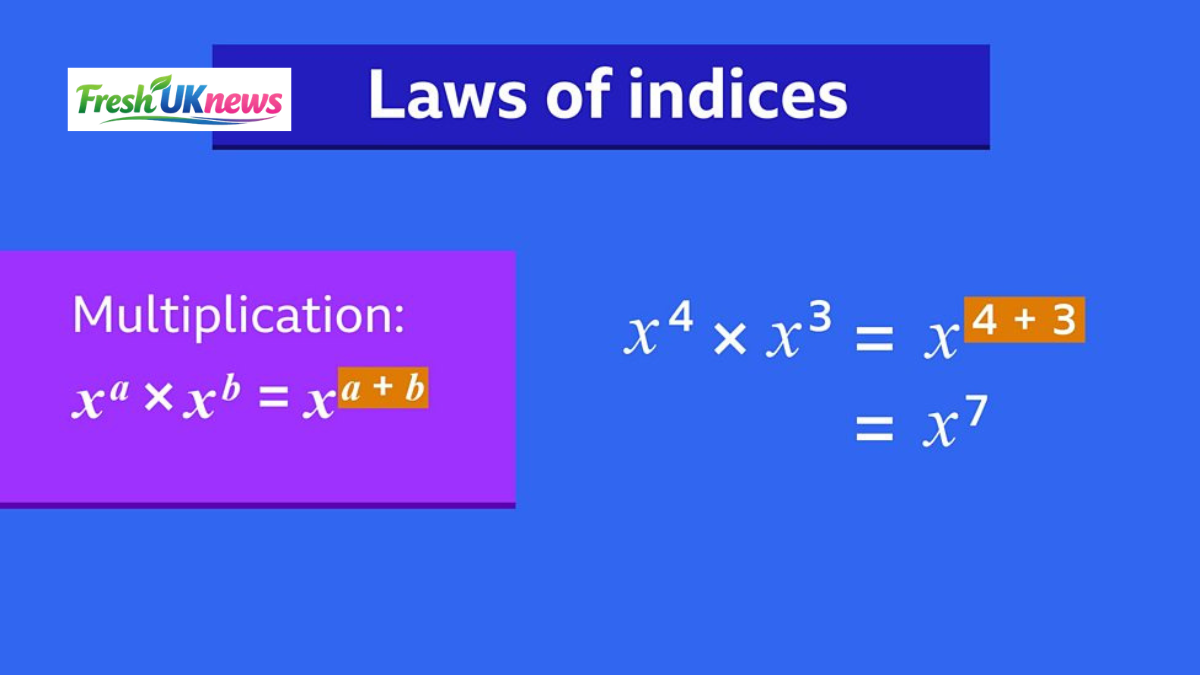
Understanding index laws is vital for GCSE maths students aiming to simplify expressions efficiently and solve algebraic problems confidently. Indices, also known as powers or exponents, show how many times a number or variable is multiplied by itself. Mastering these laws helps students reduce complex calculations into manageable steps. With consistent practice, index laws allow learners to approach questions with accuracy and save valuable time during exams.
The study of index laws also builds a strong foundation for higher-level mathematics. By learning how to manipulate powers, students gain skills applicable to algebra, geometry, and scientific calculations. Applying these rules correctly ensures clarity and consistency in mathematical operations. For anyone preparing for GCSEs, understanding index laws is more than just memorising rules; it is about developing a methodical approach to solving problems with precision.
What Are Index Laws?
Index laws are specific rules in mathematics that govern how powers behave during multiplication, division, and raising numbers to another power. These laws apply only when the base is the same, ensuring consistency in calculations. Each law provides a straightforward method to simplify expressions, which is crucial for GCSE students who often encounter complicated equations involving exponents. Learning these laws reduces errors and builds confidence when handling more advanced topics.
The primary purpose of index laws is to make repeated multiplication manageable. Instead of writing lengthy expressions like 2 × 2 × 2 × 2, index laws allow us to write 2⁴ and perform operations more efficiently. Understanding these laws ensures that students can manipulate powers without confusion and apply them to both numbers and algebraic variables, forming a cornerstone of mathematical competence.
The 6 Core Index Laws
The first key aspect of index laws is the multiplication law, where powers are added when multiplying terms with the same base. For instance, a² × a³ simplifies to a⁵. Similarly, the division law subtracts exponents when dividing, so a⁵ ÷ a² becomes a³. These basic rules make it easier to simplify expressions quickly and consistently in exam settings.
Another essential element of index laws is the power of a power law, which involves multiplying exponents when raising a term to another power, such as (a²)³ = a⁶. The zero index law declares that any non-zero number raised to the power of zero equals one. Negative indices indicate reciprocals, while fractional indices represent roots, such as square roots or cube roots. Practising these core rules ensures fluency in all areas of exponent manipulation.
Additional Rules and Tips
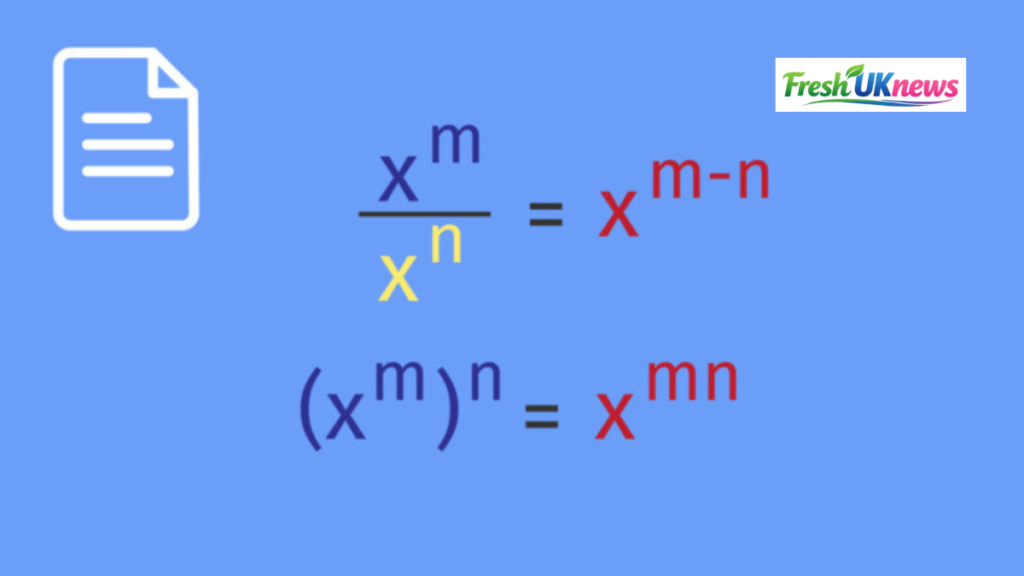
Beyond the core principles, index laws include the power of a product, which distributes an exponent across multiplication, and the power of a quotient, which applies powers to both numerator and denominator. These rules extend the applicability of index laws to more complex expressions, making them invaluable for GCSE students. The power of one law simply states that any number raised to one remains itself, which provides additional clarity in calculations.
Applying index laws successfully requires attention to detail and awareness of common mistakes. For example, mixing bases or incorrectly handling negative exponents are frequent errors. A useful tip is to always write each step clearly and check that operations align with the law being applied. With consistent practice, students can minimise errors and gain a deeper understanding of how powers interact in mathematics.
Step-by-Step Worked Examples
Practical examples are the best way to understand index laws. Multiplying a³ × a⁴ gives a⁷, illustrating the addition rule. Dividing a⁵ ÷ a² results in a³, demonstrating subtraction. Raising (a²)³ to a power yields a⁶, which exemplifies multiplying exponents. Zero and negative indices also follow predictable patterns, with zero giving one and negative exponents producing reciprocals.
Algebraic examples further reinforce index laws. For instance, (3x²)³ × (3x²)² simplifies to 3⁵x¹⁰, applying both the multiplication law and power of a power law simultaneously. Fractional indices, such as x^(1/2), represent square roots and can be applied to both numbers and variables. Working through these examples step by step helps students internalise the rules and apply them accurately in exams.
Practice Questions and Worksheets
Using worksheets is an effective way to master index laws. Practice questions should vary in difficulty, from simple numeric operations to more complex algebraic problems. Worksheets, whether printed or downloadable as PDFs, allow repeated practice and help students memorise the rules, improve speed, and enhance confidence in solving GCSE maths problems.
Consistent practice with index laws ensures that students become fluent in applying these rules under exam conditions. Gradually increasing question complexity challenges learners and prepares them for real exam scenarios. Using worksheets with step-by-step solutions also helps students identify mistakes and reinforces the correct application of each law.
Common Mistakes to Avoid
Many students struggle with index laws due to small but critical mistakes. Common errors include applying rules to different bases, confusing negative and zero indices, or forgetting to add or multiply powers correctly. Awareness of these pitfalls helps learners stay accurate and reduces exam errors.
Practising index laws carefully ensures a strong grasp of algebraic manipulations. Writing each step methodically and checking the base and exponent helps prevent errors. Regular revision and applying these laws in varied contexts improve confidence and accuracy, allowing students to tackle both standard and challenging questions with ease.
Real-Life Applications of Index Laws
Index laws are not just limited to classroom use; they are widely applied in science, engineering, and finance. For instance, powers are used in calculating compound interest, population growth models, and physics equations. Understanding how to manipulate exponents makes these applications easier and more accurate.
Real-life examples highlight the importance of index laws beyond maths exams. In technology, engineering, and data science, exponential calculations are routine. Mastering index laws enables students to approach such problems logically and efficiently, demonstrating the practical value of what might initially seem like purely theoretical rules.
Conclusion
Mastering index laws is essential for GCSE maths success. These rules simplify complex calculations, improve accuracy, and build confidence in algebra and other higher-level mathematics. By practising with examples and worksheets, students can internalise multiplication, division, zero, negative, and fractional powers. Understanding and applying index laws consistently ensures that learners are fully prepared for exams and real-world mathematical applications.
Frequently asked questions
What are index laws in maths?
Index laws are rules that explain how to work with numbers or variables raised to powers.
How many index laws are there for GCSE maths?
There are six core index laws commonly taught for GCSE maths.
Can index laws be applied to different bases?
No, index laws only apply when the base of the numbers or variables is the same.
What does a negative exponent mean in index laws?
A negative exponent indicates the reciprocal of the number or variable.
How do fractional indices work?
Fractional indices represent roots, such as square roots or cube roots.
Why is any number to the power of zero equal to one?
Any non-zero number to the power of zero equals one by the definition of exponent rules.
What are the most common mistakes with index laws?
Common mistakes include mixing bases, miscalculating negative exponents, and forgetting to add or multiply powers correctly.
Are there worksheets available for practising index laws?
Yes, many GCSE maths worksheets and PDFs are available for practising index laws.
How do index laws help in algebra and science?
Index laws simplify calculations, making algebraic manipulations and scientific computations easier.
What is the easiest way to remember all index laws?
The easiest way is to practise regularly and learn them in small, logical steps with examples.
Also Read: snowball kiss meaning