









A rhombus is one of the most fascinating quadrilaterals in geometry. Often recognised for its diamond-like shape, a rhombus has four sides of equal length, making it an equilateral quadrilateral. Unlike other four-sided figures, a rhombus combines symmetry, equal sides, and unique diagonal properties. Understanding a rhombus is essential for students, architects, and designers, as it helps in solving geometric problems and visualising patterns in both academic and real-life applications.
The rhombus is more than just a shape on paper. It frequently appears in everyday objects, such as kite patterns, floor tiles, and decorative items. Its ability to maintain symmetry and balance makes it a versatile shape for design purposes. By studying a rhombus, learners can understand concepts like angles, diagonals, and area calculations more clearly, making it a fundamental part of geometry.
What is a Rhombus? Definition Explained
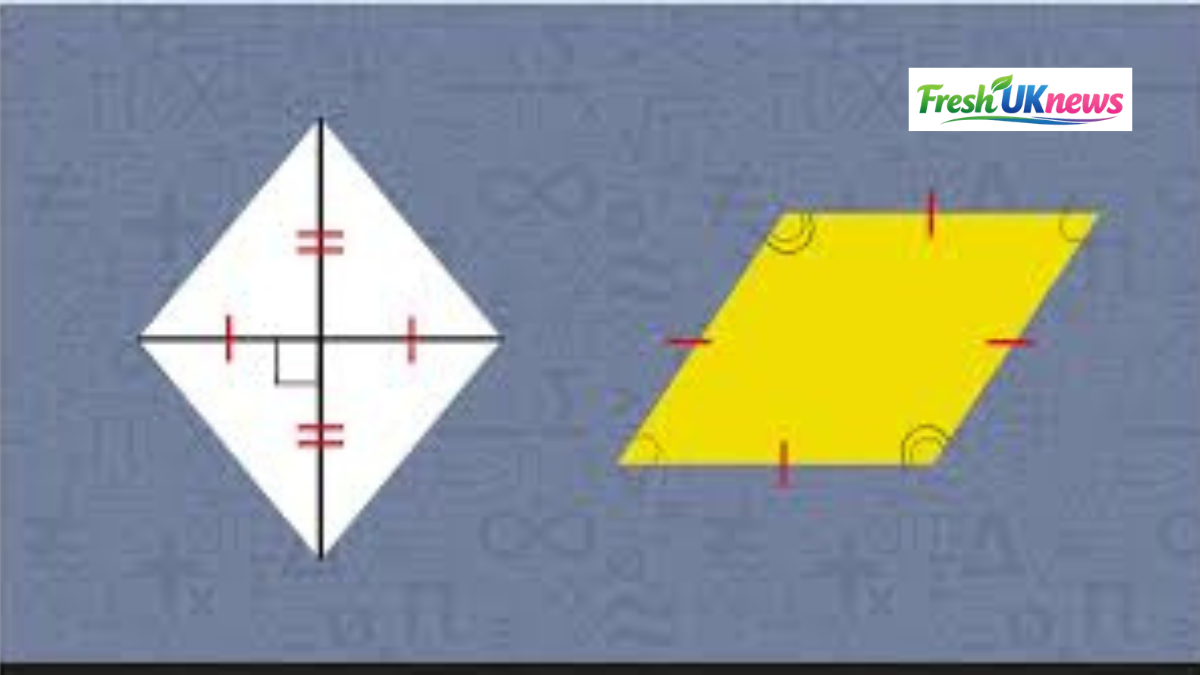
A rhombus is defined as a quadrilateral with all four sides equal in length. Unlike a square, the angles in a rhombus do not necessarily have to be right angles, although a square is technically a special type of rhombus. The rhombus is sometimes referred to as a diamond or lozenge in everyday language, but its geometric properties set it apart from these casual terms.
The diagonals of a rhombus are a key feature that distinguishes it from other quadrilaterals. They intersect at right angles and bisect the interior angles at the vertices. These characteristics allow the rhombus to maintain symmetry and make calculations like area and height more straightforward. Understanding the definition and structure of a rhombus is the first step in mastering its geometric applications.
Key Properties of a Rhombus
One of the most important properties of a rhombus is that all four sides are of equal length. This makes it an equilateral quadrilateral. Additionally, opposite angles in a rhombus are equal, and adjacent angles add up to 180 degrees. These properties make the rhombus a special type of parallelogram with unique characteristics that are important for solving geometric problems.
Diagonals in a rhombus have distinct properties. They are perpendicular to each other, meaning they intersect at 90 degrees, and they bisect the angles of the rhombus. A rhombus also possesses two lines of symmetry and rotational symmetry of order two. These symmetrical properties make it an essential shape in both theoretical geometry and practical design applications.
Types of Rhombus
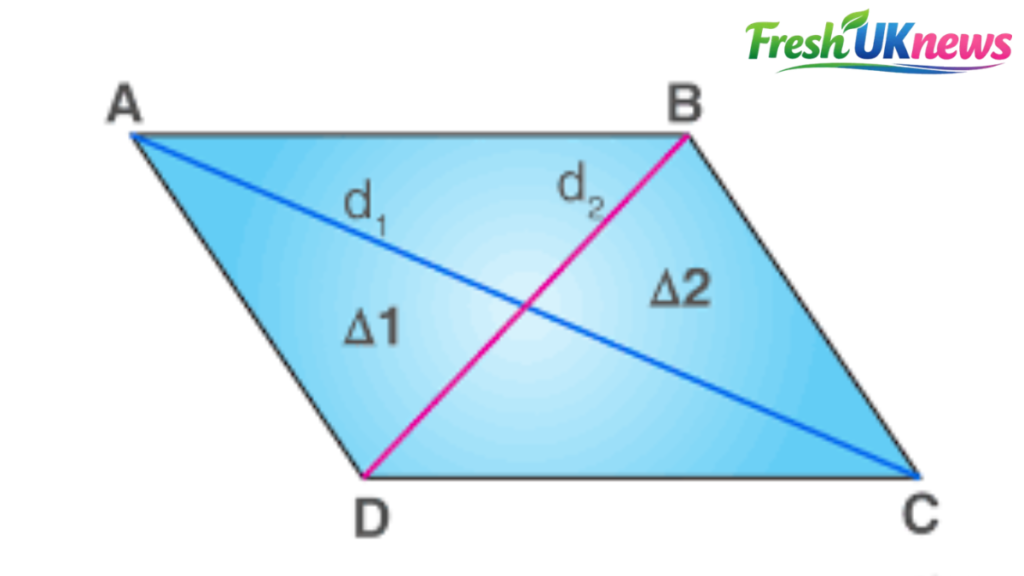
Rhombuses can vary based on their internal angles. Some rhombuses have acute and obtuse angles, giving them a stretched or skewed appearance. When all angles are right angles, the rhombus becomes a square. This flexibility allows rhombus shapes to be used in multiple scenarios while maintaining their essential properties of equal sides and perpendicular diagonals.
In addition to geometric forms, rhombuses are frequently observed in real-life objects. Examples include kites, crystals, and decorative floor patterns. Each type of rhombus, regardless of its angle configuration, retains the core property of having four sides of equal length. These forms demonstrate the practical relevance of the rhombus beyond pure mathematics.
Rhombus Formulas
Calculating the area of a rhombus can be achieved through several formulas. The most common method is using the lengths of the diagonals: area = (diagonal1 × diagonal2) ÷ 2. Another method involves the base and height: area = base × height. Both formulas allow learners to solve geometric problems accurately and efficiently, making the rhombus a versatile shape in mathematics.
The perimeter of a rhombus is calculated simply as four times the length of one side. Understanding these formulas helps students and professionals solve problems related to dimensions, tiling, and design. Practising these formulas ensures familiarity with rhombus properties and increases confidence in applying them in both academic exercises and real-world contexts.
Rhombus vs Other Quadrilaterals
The rhombus is often confused with squares, rectangles, and parallelograms, but it has distinct differences. Unlike a square, a rhombus does not require right angles. Compared to a parallelogram, all sides of a rhombus are equal, and its diagonals are perpendicular. These distinctions help in accurately identifying and classifying quadrilaterals in geometry.
A clear comparison of a rhombus with other quadrilaterals reveals its unique properties. For example, while a rectangle has equal opposite sides, only the rhombus guarantees that all four sides are equal. Recognising these differences is crucial for students, as it aids in solving complex geometric problems and understanding the relationships between different shapes.
Real-Life Applications of Rhombus
The rhombus is widely used in real-life scenarios beyond textbooks. Architectural designs, floor tiling patterns, and decorative artwork often incorporate rhombus shapes due to their symmetry and visual appeal. Its geometric balance makes it an ideal choice for both functional and aesthetic purposes in design projects.
Additionally, rhombus shapes appear in nature and everyday objects. Kites, crystal formations, and playing cards frequently exhibit rhombus patterns. Recognising these examples reinforces the practical importance of understanding the rhombus. By connecting abstract geometric concepts with tangible objects, learners can better appreciate the relevance of this versatile shape.
Common Mistakes and Misconceptions
Many students confuse a rhombus with a diamond or a square. While these terms are sometimes used interchangeably, a rhombus has specific geometric properties, including equal sides and perpendicular diagonals. Misunderstanding these properties can lead to mistakes in solving area, perimeter, and angle-related problems.
Another common error is miscalculating angles or assuming all rhombuses have right angles. Diagonals in a rhombus always intersect at right angles, but the internal angles can vary. Understanding these nuances ensures accurate identification and calculation, making the rhombus easier to work with in both academic and practical applications.
Conclusion
A rhombus is a remarkable geometric shape with equal sides, unique angles, and perpendicular diagonals. Its properties, formulas, and applications make it essential in both mathematics and everyday life. Understanding the rhombus allows learners to solve geometric problems effectively, recognise patterns, and appreciate the symmetry and balance in various designs.
By practising calculations, studying real-life examples, and comparing the rhombus with other quadrilaterals, students can gain a thorough understanding of this shape. The rhombus serves as a bridge between theoretical geometry and practical applications, demonstrating the elegance and versatility of equilateral quadrilaterals.
Frequently asked questions
What is a rhombus in simple terms?
A rhombus is a four-sided shape with all sides equal and opposite angles equal.
How do you calculate the area of a rhombus?
The area of a rhombus = (diagonal1 × diagonal2) ÷ 2 or base × height.
Is a square considered a rhombus?
Yes, a square is a special type of rhombus with all right angles.
What are the properties of a rhombus?
All sides equal, opposite angles equal, diagonals perpendicular and bisect angles, two lines of symmetry.
How many lines of symmetry does a rhombus have?
A rhombus has two lines of symmetry.
Can a rhombus have right angles?
Yes, if all angles are right angles, the rhombus becomes a square.
What is the difference between a rhombus and a diamond?
A rhombus is a geometric shape with defined properties, while a diamond is a casual term for its appearance.
What are real-life examples of a rhombus?
Kites, floor tiles, playing cards, crystals, and decorative patterns often resemble a rhombus.
Also Read: index laws